 |
|
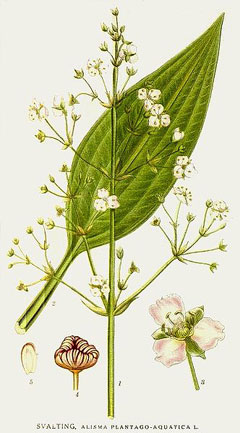
http://commons.wikimedia.org/wiki/File:484_Alisma_plantago-aquatica.jpg |
 |
| http://commons.wikimedia.org/wiki/User:Fice |
Translate this page:
Summary
Physical Characteristics

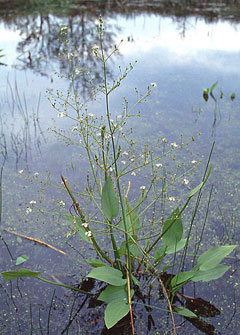
 Alisma plantago-aquatica is a PERENNIAL growing to 0.9 m (3ft) by 0.5 m (1ft 8in).
See above for USDA hardiness. It is hardy to UK zone 6. It is in flower from June to August, and the seeds ripen from July to September. The species is hermaphrodite (has both male and female organs) and is pollinated by Flies.
Suitable for: light (sandy), medium (loamy) and heavy (clay) soils. Suitable pH: mildly acid, neutral and basic (mildly alkaline) soils. It cannot grow in the shade. It prefers wet soil and can grow in water.
UK Hardiness Map
US Hardiness Map
Synonyms
A. parviflorum. A. subcordatum. A. triviale. Pursh.
Plant Habitats
Pond; Bog Garden;
Edible Uses
Edible Parts: Leaves Root
Edible Uses:
Root - cooked[13, 46, 61, 74]. Rich in starch[114]. Caution is advised, the root is acrid if it is not dried or well cooked before use[2, 183]. Leaves and petioles - must be thoroughly cooked. They require long boiling and have a salty flavour[105, 179].
References More on Edible Uses
Medicinal Uses
Plants For A Future can not take any responsibility for any adverse effects from the use of plants. Always seek advice from a professional before using a plant medicinally.
Antibacterial Anticholesterolemic Astringent Contraceptive Diaphoretic Diuretic Dysentery Hypoglycaemic
Hypotensive Leprosy Rubefacient
The leaves are antibacterial, anticholesterolemic, diaphoretic, diuretic, hypoglycaemic and hypotensive[4, 147, 176]. They are used in the treatment of cystitis, dysentery, renal calculus, gravel etc[4]. The fresh leaf is rubefacient[222]. It is used in the treatment of leprosy[218] and is also applied locally to bruises and swellings[4]. Dried stem bases eaten, or grated and taken with water in treating digestive disorders such as heartburn, cramps and stomach flu[257]. The powdered seed is an astringent, used in cases of bleeding[4]. The seed is also said to promote sterility[218]. The root contains an essential oil and has a wide range of medicinal uses[176, 218, 283]. It is antibacterial, anticholesterolemic, diuretic and hypotensive[176]. It is said to lower blood pressure, cholesterol and blood sugar levels[238] whilst it also has an antibacterial action on Staphylococcus, Pneumococci and Mycobacterium[176]. The root is used in the treatment of oliguria, oedema, nephritis, acute diarrhoea, cholesterolaemia and fatty liver[176]. It has been thought of as a cure for rabies, though this has not been substantiated[4]. The whole plant is believed to promote conception[218]. The root is harvested before the plant comes into flower and is dried for later use[238]. A homeopathic remedy is obtained from the fresh root[4].
References More on Medicinal Uses
The Bookshop: Edible Plant Books
Our Latest books on Perennial Plants For Food Forests and Permaculture Gardens in paperback or digital formats.
Edible Tropical Plants
Food Forest Plants for Hotter Conditions: 250+ Plants For Tropical Food Forests & Permaculture Gardens.
More
Edible Temperate Plants
Plants for Your Food Forest: 500 Plants for Temperate Food Forests & Permaculture Gardens.
More
More Books
PFAF have eight books available in paperback and digital formats. Browse the shop for more information.
Shop Now
Other Uses
References More on Other Uses
Cultivation details
Succeeds in a sunny position in boggy ground or shallow water up to 25cm deep[200]. Plants often self-sow aggressively when in a suitable position[1, 56]. The subspecies A. plantago-maritima orientale. Sam. is the form used medicinally in China[176]. The subspecies A. plantago-maritima parviflorum (Syn A. parviflorum, A. subcordatum) is the form used medicinally in America[222]. Plants are very attractive to slugs[K].
References Carbon Farming Information and Carbon Sequestration Information
Temperature Converter
Type a value in the Celsius field to convert the value to Fahrenheit:
Fahrenheit:
The PFAF Bookshop
Plants For A Future have a number of books available in paperback and digital form. Book titles include Edible Plants, Edible Perennials, Edible Trees,Edible Shrubs, Woodland Gardening, and Temperate Food Forest Plants. Our new book is Food Forest Plants For Hotter Conditions (Tropical and Sub-Tropical).
Shop Now
Plant Propagation
Seed - best sown in a cold frame as soon as it is ripe. Place the pot in about 3cm of water to keep the soil wet. Pot up the seedlings when large enough to handle and keep in the cold frame for the first winter, planting out in late spring. Division in spring or autumn. Fairly easy, the divisions can be planted straight out into their permanent positions.
Other Names
If available other names are mentioned here
Native Plant Search
Search over 900 plants ideal for food forests and permaculture gardens. Filter to search native plants to your area. The plants selected are the plants in our book 'Plants For Your Food Forest: 500 Plants for Temperate Food Forests and Permaculture Gardens, as well as plants chosen for our forthcoming related books for Tropical/Hot Wet Climates and Mediterranean/Hot Dry Climates. Native Plant Search
Found In
Countries where the plant has been found are listed here if the information is available
Weed Potential
Right plant wrong place. We are currently updating this section.
Please note that a plant may be invasive in one area but may not in your area so it’s worth checking.
Conservation Status
IUCN Red List of Threatened Plants Status :

Growth: S = slow M = medium F = fast. Soil: L = light (sandy) M = medium H = heavy (clay). pH: A = acid N = neutral B = basic (alkaline). Shade: F = full shade S = semi-shade N = no shade. Moisture: D = dry M = Moist We = wet Wa = water.

Expert comment
Author
L.
Botanical References
17200
Links / References
For a list of references used on this page please go here
Readers comment
| Add a comment |
|
If you have important information about this plant that may help other users please add a comment or link below. Only comments or links that are felt to be directly relevant to a plant will be included. If you think a comment/link or information contained on this page is inaccurate or misleading we would welcome your feedback at [email protected]. If you have questions about a plant please use the Forum on this website as we do not have the resources to answer questions ourselves.
* Please note: the comments by website users are not necessarily those held by PFAF and may give misleading or inaccurate information.
To leave a comment please Register or login here All comments need to be approved so will not appear immediately.
|
Subject : Alisma plantago-aquatica
|
|
|
|