 |
|
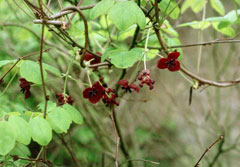
(c) ken Fern, Plants For A Future 2010 |
 |
|
Translate this page:
Summary
Bloom Color: Purple, Red.
Main Bloom Time: Early spring, Late spring, Mid spring. Form: Variable height, Variable spread.
Physical Characteristics

 Akebia quinata is a deciduous Climber growing to 12 m (39ft 4in) at a fast rate.
See above for USDA hardiness. It is hardy to UK zone 5 and is not frost tender. It is in flower from April to May, and the seeds ripen from September to October. The species is monoecious (individual flowers are either male or female, but both sexes can be found on the same plant). The plant is not self-fertile.
Suitable for: light (sandy), medium (loamy) and heavy (clay) soils and prefers well-drained soil. Suitable pH: mildly acid, neutral and basic (mildly alkaline) soils. It can grow in full shade (deep woodland) semi-shade (light woodland) or no shade. It prefers moist soil and can tolerate drought.
UK Hardiness Map
US Hardiness Map
Synonyms
Rajania quinata.
Plant Habitats
Woodland Garden Sunny Edge; Dappled Shade; Shady Edge; Ground Cover; North Wall. By. East Wall. By. West Wall. By.
Edible Uses
Edible Parts: Fruit Leaves Shoots
Edible Uses: Tea
Fruit - raw[2, 105, 177]. Sweet but insipid[3]. The fruit has a delicate flavour and a soft, juicy texture[K]. Lemon juice is sometimes added to the fruit to enhance the flavour[183]. The bitter skin of the fruit is fried and eaten[183]. The fruit is 5 - 10cm long and up to 4m wide[200, 266]. Soft young shoots are used in salads or pickled[183]. The leaves are used as a tea substitute[105, 177, 183].
References More on Edible Uses
Medicinal Uses
Plants For A Future can not take any responsibility for any adverse effects from the use of plants. Always seek advice from a professional before using a plant medicinally.
Anodyne Antiphlogistic Bitter Cancer Contraceptive Depurative Diaphoretic Diuretic
Emmenagogue Febrifuge Galactogogue Laxative Resolvent Stimulant Stomachic
Urinary Vulnerary
The stems are anodyne, antifungal, antiphlogistic, bitter, diaphoretic, diuretic, emmenagogue, febrifuge, laxative, galactogogue, resolvent, stimulant, stomachic and vulnerary[174, 178, 218, 238]. Taken internally, it controls bacterial and fungal infections and is used in the treatment of urinary tract infections, lack of menstruation, to improve lactation etc[238]. The stems are harvested in the autumn and dried for later use[238]. The fruit is antirheumatic, depurative, diuretic, febrifuge, stomachic and tonic[218]. It is a popular remedy for cancer[218]. The root is febrifuge[218]. The plant was ranked 13th in a survey of 250 potential antifertility plants in China[218].
References More on Medicinal Uses
The Bookshop: Edible Plant Books
Our Latest books on Perennial Plants For Food Forests and Permaculture Gardens in paperback or digital formats.

Edible Tropical Plants
Food Forest Plants for Hotter Conditions: 250+ Plants For Tropical Food Forests & Permaculture Gardens.
More

Edible Temperate Plants
Plants for Your Food Forest: 500 Plants for Temperate Food Forests & Permaculture Gardens.
More

More Books
PFAF have eight books available in paperback and digital formats. Browse the shop for more information.
Shop Now
Other Uses
Basketry
The peeled stems are very pliable and can be used in basket making[174]. Plants have sometimes been used as a ground cover, but their growth method does not lend itself to this use[208]. Scented. Landscape Uses Arbor. A. quinata is a specimen plant used in ornamental gardens and managed landscapes [1-8]. A. quinata seeds produce an oil used in traditional soap making in China [1-8].
Special Uses
Food Forest Ground cover Scented Plants
References More on Other Uses
Cultivation details
Akebia quinata is a reasonably hardy plant - when dormant, it can tolerate temperatures down to about -20 to -30°c. However, plants can be somewhat tender when young - new growth in spring can be damaged even by light frosts[11, 200, 1691 ]. Akebia quinata requires a well-drained moisture retentive soil [200 ]. A. quinata is both shade and drought tolerant[1-8]. It prefers good loamy soil [11 ] and succeeds in acid or alkaline soils[200 ]. It prefers partial shade but thrives in full sun[3, 200 ] and succeeds on shady walls [219 ]. It is best to grow the plants in a position that is sheltered from the early morning sun, especially in spring, to help protect them from potential frost damage[K ]. Plants are fast growing and can be invasive[200 ]. Plants are resentful of root disturbance - either grow the plants in containers before planting them out or plant them out whilst very young[219 ]. Plants are generally not pruned; if they grow too large, they can be cut back by trimming them with shears in early spring[202 ]. The flowers have a spicy fragrance reminiscent of vanilla[219 ]. Plants are shy to fruit outside their native range - possibly require some protection in the flowering season, so hand pollination is advisable[3, 11 ]. Plants are probably self-sterile[11, 182 ]; if possible, at least two plants should be grown, each from a different source. Plants in this genus are notably resistant to honey fungus [200 ]. Special Features:
Not North American native, Fragrant flowers, Attractive flowers or blooms. In garden design and the above-ground architecture of a plant, root structure considerations help choose plants that work together for their optimal soil requirements, including nutrients and water. The root pattern is branching: a heart root, dividing from the crown into several primary roots going down and out. The root pattern is suckering with new plants from underground runners away from the plant [2-1].
References Carbon Farming Information and Carbon Sequestration Information
Temperature Converter
Type a value in the Celsius field to convert the value to Fahrenheit:
Fahrenheit:
The PFAF Bookshop
Plants For A Future have a number of books available in paperback and digital form. Book titles include Edible Plants, Edible Perennials, Edible Trees,Edible Shrubs, Woodland Gardening, and Temperate Food Forest Plants. Our new book is Food Forest Plants For Hotter Conditions (Tropical and Sub-Tropical).
Shop Now
Plant Propagation
Seed - best sown in a cold frame as soon as it is ripe. Surface sow in a light position[133]. The seed usually germinates in 1 - 3 months at 15°c[133]. Stored seed should be given 1 month cold stratification[113, 133] and can be very difficult to germinate. When large enough to handle, prick the seedlings out into individual pots and grow them on in light shade in the greenhouse for at least their first winter. Plant out in late spring or early summer, after the last expected frosts. Cuttings of half-ripe wood, July/August in a frame[11, 113]. The cuttings can be slow to root[200]. Cuttings can also be taken of soft wood in spring[113]. Root cuttings, December in a warm greenhouse[113]. Layering in early spring[1]. Very easy, the plants usually self-layer and so all you need to do is dig up the new plants and plant them out directly into their permanent positions.
Other Names
If available other names are mentioned here
Akebi, Eureumdeonggul, Mu tong fruit, Urum, Five leaf akebia, Chocolate Vine [1-4].
Native Plant Search
Search over 900 plants ideal for food forests and permaculture gardens. Filter to search native plants to your area. The plants selected are the plants in our book 'Plants For Your Food Forest: 500 Plants for Temperate Food Forests and Permaculture Gardens, as well as plants chosen for our forthcoming related books for Tropical/Hot Wet Climates and Mediterranean/Hot Dry Climates. Native Plant Search
Found In
Countries where the plant has been found are listed here if the information is available
Asia, Australia, Britain, Canada, China, Japan, Korea, North America, Pakistan, UK, USA, Native to China [1-4]. A. quinata is a well-documented, adventive vine native to eastern Asia, eastern central China, Japan and Korea. It has been introduced into parts of North America, Europe and Australia 1-8].
Weed Potential
Right plant wrong place. We are currently updating this section.
Please note that a plant may be invasive in one area but may not in your area so it’s worth checking.
A. quinata is a highly invasive, aggressive vine native to eastern Asia, eastern central China, Japan and Korea. It has been introduced into Canada, Europe, Oceania and the USA. Here it poses a dangerous risk to ecosystems by readily naturalizing in suitable climates. A. quinata grows quickly by vegetative means where it can outcompete and replace existing flora, including understory shrubs and young trees. Its dense growth shades out sunlight preventing seed germination and establishment of seedlings of native plants. The dense shade created by A. quinata can kill existing species [1-8].
Conservation Status
IUCN Red List of Threatened Plants Status :

Growth: S = slow M = medium F = fast. Soil: L = light (sandy) M = medium H = heavy (clay). pH: A = acid N = neutral B = basic (alkaline). Shade: F = full shade S = semi-shade N = no shade. Moisture: D = dry M = Moist We = wet Wa = water.

Expert comment
Author
(Thunb.)Decne.
Botanical References
1158200
Links / References
For a list of references used on this page please go here
Readers comment