 |
|
http://commons.wikimedia.org/wiki/User:Raul654 |
 |
| http://commons.wikimedia.org/wiki/User:JoJan |
Translate this page:
Summary
Bloom Color: White, Yellow. Form: Rounded.
Physical Characteristics

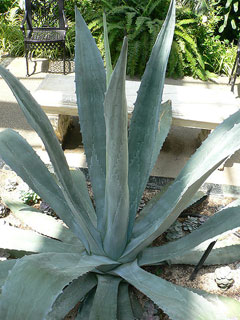
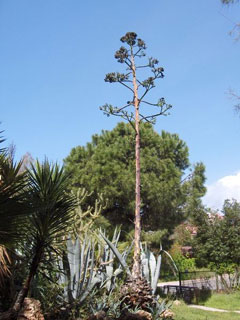
 Agave americana is an evergreen Perennial growing to 7.5 m (24ft) by 2.5 m (8ft) at a slow rate.
See above for USDA hardiness. It is hardy to UK zone 9 and is not frost tender. It is in leaf all year. The species is hermaphrodite (has both male and female organs) and is pollinated by Lepidoptera (Moths & Butterflies), bats.
Suitable for: light (sandy) and medium (loamy) soils and prefers well-drained soil. Suitable pH: mildly acid, neutral and basic (mildly alkaline) soils. It cannot grow in the shade. It prefers dry or moist soil and can tolerate drought.
UK Hardiness Map
US Hardiness Map
Synonyms
Plant Habitats
Cultivated Beds; South Wall. By. West Wall. By.
Edible Uses
Edible Parts: Leaves Sap Seed Stem
Edible Uses:
The heart of the plant is very rich in saccharine matter and can be eaten when baked[2, 92, 183]. Sweet and nutritious, but rather fibrous[213]. It is partly below ground[85]. Seed - ground into a flour and used as a thickener in soups or used with cereal flours when making bread[92]. Flower stalk - roasted[92, 95]. Used like asparagus[183]. Sap from the cut flowering stems is used as a syrup[177] or fermented into pulque or mescal[183]. The sap can also be tapped by boring a hole into the middle of the plant at the base of the flowering stem[213].
References More on Edible Uses
Medicinal Uses
Plants For A Future can not take any responsibility for any adverse effects from the use of plants. Always seek advice from a professional before using a plant medicinally.
Antiseptic Diaphoretic Diuretic Dysentery Laxative Miscellany Miscellany Odontalgic
VD
The sap of agaves has long been used in Central America as a binding agent for various powders used as poultices on wounds[254]. The sap can also be taken internally in the treatment of diarrhoea, dysentery etc[254]. The sap is antiseptic, diaphoretic, diuretic and laxative[21, 218, 240]. An infusion of the chopped leaf is purgative and the juice of the leaves is applied to bruises[218]. The plant is used internally in the treatment of indigestion, flatulence, constipation, jaundice and dysentery[238]. The sap has disinfectant properties and can be taken internally to check the growth of putrefactive bacteria in the stomach and intestines[21]. Water in which agave fibre has been soaked for a day can be used as a scalp disinfectant and tonic in cases of falling hair[21]. Steroid drug precursors are obtained from the leaves[238]. A gum from the root and leaf is used in the treatment of toothache[218]. The root is diaphoretic and diuretic[240]. It is used in the treatment of syphilis[218, 240]. All parts of the plant can be harvested for use as required, they can also be dried for later use. The dried leaves and roots store well[238].
References More on Medicinal Uses
The Bookshop: Edible Plant Books
Our Latest books on Perennial Plants For Food Forests and Permaculture Gardens in paperback or digital formats.

Edible Tropical Plants
Food Forest Plants for Hotter Conditions: 250+ Plants For Tropical Food Forests & Permaculture Gardens.
More

Edible Temperate Plants
Plants for Your Food Forest: 500 Plants for Temperate Food Forests & Permaculture Gardens.
More

More Books
PFAF have eight books available in paperback and digital formats. Browse the shop for more information.
Shop Now
Other Uses
Fibre Insecticide Miscellany Miscellany Needles Paper Pins Soap Soil reclamation Thatching
The plant contains saponins. An extract of the leaves is used as a soap[2]. The roots are used according to another report[238]. It is likely that the root is the best source of the saponins that are used to make a soap[K]. Chop up the leaves or the roots into small pieces and then simmer them in water to extract the saponins. Do not over boil or you will start to break down the saponins[K]. There is a report that the plant has insecticidal properties, but further details are not given[218, 238]. A very strong fibre obtained from the leaves is used for making rope, coarse fabrics etc[2, 61, 92, 238]. A paper can also be made from the leaves[2]. The thorns on the leaves are used as pins and needles[2]. The dried flowering stems are used as a waterproof thatch[2] and as a razor strop[89]. The plants are used in land-reclamation schemes in arid areas of the world[238].
Special Uses
Carbon Farming
References More on Other Uses
Cultivation details
Management: Standard Regional Crop Staple Crop: Basic Starch Staple Crop: Sugar
Landscape Uses:Container, Massing, Rock garden, Seashore, Specimen. Requires a very well-drained soil and a sunny position[1, 200]. The agave is not very hardy in Britain tolerating temperatures down to about -3°c if conditions are not wet[260]. It succeeds outdoors on the south coast of England from Torbay westwards[11]. Plants survived lower temperatures during the very cold winters from 1985/1987 and were unharmed at Glendurgan gardens in West Cornwall[K]. A monocarpic species, the plant lives for a number of years without flowering but dies once it does flower. However, it normally produces plenty of suckers during its life and these continue growing, taking about 10 - 15 years in a warm climate, considerably longer in colder ones, before flowering[11]. This plant is widely used by the native people in its wild habitat, it has a wide range of uses. In a warm climate suckers take 10 - 15 years to come into flower. Members of this genus are rarely if ever troubled by browsing deer[233]. Special Features:Attracts birds, Attractive foliage, North American native, Naturalizing, All or parts of this plant are poisonous, Flowers are rare, Blooms are very showy.
Carbon Farming
-
Management: Standard
Plants grow to their standard height. Harvest fruit, seeds, or other products. Non-Destructive management systems.
-
Regional Crop
These crops have been domesticated and cultivated regionally but have not been adopted elsewhere and are typically not traded globally, Examples in this broad category include perennial cottons and many nuts and staple fruits.
-
Staple Crop: Basic Starch
The Carbon Farming Solution. Eric Toensmeier.
-
Staple Crop: Sugar
Perennial sugar crops include sugarcane and compare favorably to annuals.
References Carbon Farming Information and Carbon Sequestration Information
Temperature Converter
Type a value in the Celsius field to convert the value to Fahrenheit:
Fahrenheit:
The PFAF Bookshop
Plants For A Future have a number of books available in paperback and digital form. Book titles include Edible Plants, Edible Perennials, Edible Trees,Edible Shrubs, Woodland Gardening, and Temperate Food Forest Plants. Our new book is Food Forest Plants For Hotter Conditions (Tropical and Sub-Tropical).
Shop Now
Plant Propagation
Seed - surface sow in a light position, April in a warm greenhouse. The seed usually germinates in 1 - 3 months at 20°c[133]. Prick out the seedlings into individual pots of well-drained soil when they are large enough to handle and grow them on in a sunny position in the greenhouse until they are at least 20cm tall. Plant out in late spring or early summer, after the last expected frosts, and give some protection from the cold for at least their first few winters[K]. Offsets can be potted up at any time they are available. Keep in a warm greenhouse until they are well established[200].
Other Names
If available other names are mentioned here
Native Plant Search
Search over 900 plants ideal for food forests and permaculture gardens. Filter to search native plants to your area. The plants selected are the plants in our book 'Plants For Your Food Forest: 500 Plants for Temperate Food Forests and Permaculture Gardens, as well as plants chosen for our forthcoming related books for Tropical/Hot Wet Climates and Mediterranean/Hot Dry Climates. Native Plant Search
Found In
Countries where the plant has been found are listed here if the information is available
Weed Potential
Right plant wrong place. We are currently updating this section.
Please note that a plant may be invasive in one area but may not in your area so it’s worth checking.
Conservation Status
IUCN Red List of Threatened Plants Status :

Growth: S = slow M = medium F = fast. Soil: L = light (sandy) M = medium H = heavy (clay). pH: A = acid N = neutral B = basic (alkaline). Shade: F = full shade S = semi-shade N = no shade. Moisture: D = dry M = Moist We = wet Wa = water.

Expert comment
Author
L.
Botanical References
1172200
Links / References
For a list of references used on this page please go here
Readers comment
© 2010, Plants For A Future. Plants For A Future is a charitable company limited by guarantee, registered in England and Wales. Charity No. 1057719, Company No. 3204567.