 |
|
|
 |
| http://pl.wikipedia.org/wiki/Wikipedysta:Ala_z |
Translate this page:
Summary
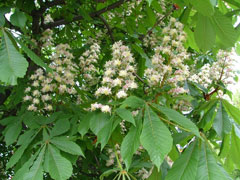
Bloom Color: White.
Main Bloom Time: Early spring, Late spring, Mid spring. Form: Oval, Pyramidal.
Physical Characteristics

 Aesculus hippocastanum is a deciduous Tree growing to 30 m (98ft) by 15 m (49ft) at a fast rate.
See above for USDA hardiness. It is hardy to UK zone 3 and is not frost tender. It is in flower in May, and the seeds ripen in September. The species is hermaphrodite (has both male and female organs) and is pollinated by Bees.
Suitable for: light (sandy), medium (loamy) and heavy (clay) soils, prefers well-drained soil and can grow in nutritionally poor soil. Suitable pH: mildly acid, neutral and basic (mildly alkaline) soils. It can grow in semi-shade (light woodland) or no shade. It prefers dry or moist soil. The plant can tolerates strong winds but not maritime exposure.
It can tolerate atmospheric pollution.
UK Hardiness Map
US Hardiness Map
Synonyms
Aesculus asplenifolia. Aesculus castanea. Aesculus memmingeri. Aesculus procera.
Plant Habitats
Woodland Garden Canopy;
Edible Uses
Edible Parts: Seed
Edible Uses: Coffee
The roasted seed is used as a coffee substitute[2, 7]. Seed - cooked. It can be dried, ground into a powder and used as a gruel[7, 46, 55, 61]. The seed is quite large, about 3cm in diameter, and is easily harvested. It is usually produced in abundance in Britain. Unfortunately the seed is also rich in saponins, these must be removed before it can be used as a food and this process also removes many of the minerals and vitamins, leaving behind mainly starch. See also the notes above on toxicity. The seed contains up to 40% water, 8 - 11% protein and 8 - 26% toxic saponins[218]. The following notes apply to A. californica, but are probably also relevant here:- The seed needs to be leached of toxins before it becomes safe to eat - the Indians would do this by slow-roasting the nuts (which would have rendered the saponins harmless) and then cutting them into thin slices, putting them into a cloth bag and rinsing them in a stream for 2 - 5 days[213].
References More on Edible Uses
Medicinal Uses
Plants For A Future can not take any responsibility for any adverse effects from the use of plants. Always seek advice from a professional before using a plant medicinally.
Alterative Analgesic Antiinflammatory Antirheumatic Astringent Bach Diuretic Dysentery
Expectorant Febrifuge Haemostatic Malaria Narcotic Tonic Vasoconstrictor
Vulnerary
Horse chestnut is an astringent, anti-inflammatory herb that helps to tone the vein walls which, when slack or distended, may become varicose, haemorrhoidal or otherwise problematic[254]. The plant also reduces fluid retention by increasing the permeability of the capillaries and allowing the re-absorption of excess fluid back into the circulatory system[254]. This plant is potentially toxic if ingested and should not be used internally without professional supervision[254]. Alterative, analgesic, haemostatic and vulnerary[165, 218]. The bark is anti-inflammatory, astringent, diuretic, febrifuge, narcotic, tonic and vasoconstrictive[4, 7, 222]. It is harvested in the spring and dried for later use[4]. The plant is taken in small doses internally for the treatment of a wide range of venous diseases, including hardening of the arteries, varicose veins, phlebitis, leg ulcers, haemorrhoids and frostbite[238, 254]. It is also made into a lotion or gel for external application[254]. A tea made from the bark is used in the treatment of malaria and dysentery, externally in the treatment of lupus and skin ulcers[4, 222]. A tea made from the leaves is tonic and is used in the treatment of fevers and whooping cough[222, 240, 254]. The pericarp is peripherally vasoconstrictive[7]. The seeds are decongestant, expectorant and tonic[7, 21]. They have been used in the treatment of rheumatism, neuralgia and haemorrhoids[4]. They are said to be narcotic and that 10 grains of the nut are equal to 3 grains of opium[213]. An oil extracted from the seeds has been used externally as a treatment for rheumatism[254]. A compound of the powdered roots is analgesic and has been used to treat chest pains[257]. The buds are used in Bach flower remedies - the keywords for prescribing it are 'Failure to learn by experience', 'Lack of observation in the lessons of life' and hence 'The need of repetition'[209]. The flowers are used in Bach flower remedies - the keywords for prescribing it are 'Persistent unwanted thoughts' and 'Mental arguments and conversations'[209]. The German Commission E Monographs, a therapeutic guide to herbal medicine, approve Aesculus hippocastanum for chronic venous insufficiency in the legs (see [302] for critics of commission E).
References More on Medicinal Uses
The Bookshop: Edible Plant Books
Our Latest books on Perennial Plants For Food Forests and Permaculture Gardens in paperback or digital formats.

Edible Tropical Plants
Food Forest Plants for Hotter Conditions: 250+ Plants For Tropical Food Forests & Permaculture Gardens.
More

Edible Temperate Plants
Plants for Your Food Forest: 500 Plants for Temperate Food Forests & Permaculture Gardens.
More

More Books
PFAF have eight books available in paperback and digital formats. Browse the shop for more information.
Shop Now
Other Uses
Dye Soap Starch Tannin Wood
Saponins in the seed are used as a soap substitute[169]. The saponins can be easily obtained by chopping the seed into small pieces and infusing them in hot water. This water can then be used for washing the body, clothes etc. Its main drawback is a lingering odour of horse chestnuts[K]. The seed contains variable amounts of saponins, up to a maximum of 10%[240]. A starch obtained from the seed is used in laundering[100]. The bark and other parts of the plant contain tannin, but the quantities are not given[223]. A yellow dye is obtained from the bark[4]. The flowers contain the dyestuff quercetin[223]. Wood - soft, light, not durable. Of little commercial value, it is used for furniture, boxes, charcoal[2, 11, 46, 61].
Special Uses
Scented Plants
References More on Other Uses
Cultivation details
Landscape Uses:Firewood, Pollard, Specimen, Street tree. Prefers a deep loamy well-drained soil but is not too fussy tolerating poorer drier soils[11, 200]. Tolerates exposed positions and atmospheric pollution[200]. A very ornamental and fast-growing tree[1, 4], it succeeds in most areas of Britain but grows best in eastern and south-eastern England[200]. Trees are very hardy when dormant, but the young growth in spring can be damaged by late frosts. The flowers have a delicate honey-like perfume[245]. Trees are tolerant of drastic cutting back and can be severely lopped[200]. They are prone to suddenly losing old heavy branches[98]. The tree comes into bearing within 20 years from seed[98]. Most members of this genus transplant easily, even when fairly large[11]. Special Features:
Attractive foliage, Not North American native, Naturalizing, Blooms are very showy.
References Carbon Farming Information and Carbon Sequestration Information
Temperature Converter
Type a value in the Celsius field to convert the value to Fahrenheit:
Fahrenheit:
The PFAF Bookshop
Plants For A Future have a number of books available in paperback and digital form. Book titles include Edible Plants, Edible Perennials, Edible Trees,Edible Shrubs, Woodland Gardening, and Temperate Food Forest Plants. Our new book is Food Forest Plants For Hotter Conditions (Tropical and Sub-Tropical).
Shop Now
Plant Propagation
Seed - best sown outdoors or in a cold frame as soon as it is ripe[11, 80]. The seed germinates almost immediately and must be given protection from severe weather[130]. The seed has a very limited viability and must not be allowed to dry out. Stored seed should be soaked for 24 hours prior to sowing and even after this may still not be viable[80, 113]. It is best to sow the seed with its 'scar' downwards[130]. If sowing the seed in a cold frame, pot up the seedlings in early spring and plant them out into their permanent positions in the summer.
Other Names
If available other names are mentioned here
Native Plant Search
Search over 900 plants ideal for food forests and permaculture gardens. Filter to search native plants to your area. The plants selected are the plants in our book 'Plants For Your Food Forest: 500 Plants for Temperate Food Forests and Permaculture Gardens, as well as plants chosen for our forthcoming related books for Tropical/Hot Wet Climates and Mediterranean/Hot Dry Climates. Native Plant Search
Found In
Countries where the plant has been found are listed here if the information is available
Weed Potential
Right plant wrong place. We are currently updating this section.
Please note that a plant may be invasive in one area but may not in your area so it’s worth checking.
Conservation Status
IUCN Red List of Threatened Plants Status :

Growth: S = slow M = medium F = fast. Soil: L = light (sandy) M = medium H = heavy (clay). pH: A = acid N = neutral B = basic (alkaline). Shade: F = full shade S = semi-shade N = no shade. Moisture: D = dry M = Moist We = wet Wa = water.

Expert comment
Author
L.
Botanical References
1150200
Links / References
For a list of references used on this page please go here
Readers comment