 |
|
|
 |
| http://commons.wikimedia.org/wiki/File:Aegopodium_podagraria_001.JPG |
Translate this page:
Summary
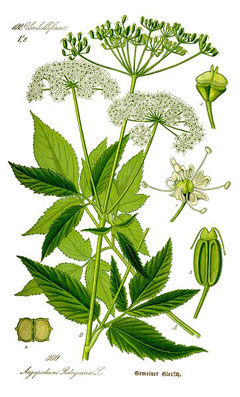
Aegopodium podagraria. Ground Elder is a vigorous and very invasive perennial, growing about 60cm tall and spreading rapidly by its roots. It is very difficult to eradicate because any small piece of root left in the ground will quickly regrow. Whilst it is occasionally grown as a ground cover in the wilder parts of the garden (shrubs and strong growing bulbs such as some lilies grow very well through it), it really is too vigorous for most other herbaceous species. There is, however, a variegated form of this species that is less invasive and is sometimes grown in the ornamental garden. Ground Elder has a long history of edible and medicinal use; indeed it was cultivated as a food crop and medicinal herb in the Middle Ages. It was used mainly as a food that could counteract gout, one of the effects of the rich foods eaten by monks, bishops etc at this time. The leaves can be eaten raw or cooked and have an unusual tangy flavour which is an acquired taste, although some people like it.
Physical Characteristics

 Aegopodium podagraria is a PERENNIAL growing to 0.6 m (2ft) by 1 m (3ft 3in) at a fast rate.
See above for USDA hardiness. It is hardy to UK zone 5 and is not frost tender. It is in flower from May to July. The species is hermaphrodite (has both male and female organs) and is pollinated by Bees, flies. The plant is self-fertile.
Suitable for: light (sandy), medium (loamy) and heavy (clay) soils. Suitable pH: mildly acid, neutral and basic (mildly alkaline) soils. It can grow in full shade (deep woodland) semi-shade (light woodland) or no shade. It prefers moist soil.
UK Hardiness Map
US Hardiness Map
Synonyms
Plant Habitats
Woodland Garden Dappled Shade; Shady Edge; not Deep Shade; Ground Cover; Hedgerow;
Edible Uses
Edible Parts: Leaves
Edible Uses:
Leaves - raw or cooked[2, 4, 5, 12, 54, 100]. An unusual tangy flavour[183], the majority of people we give it to do not like it[K] although some reports say that it makes a delicious vegetable[244]. The leaves are best harvested before the plant comes into flower, they can be used in salads, soups, or cooked as a vegetable[9].
References More on Edible Uses
Medicinal Uses
Plants For A Future can not take any responsibility for any adverse effects from the use of plants. Always seek advice from a professional before using a plant medicinally.
Antirheumatic Diuretic Sedative Vulnerary
Ground Elder has a long history of medicinal use and was cultivated as a food crop and medicinal herb in the Middle Ages. The plant was used mainly as a food that could counteract gout, one of the effects of the rich foods eaten by monks, bishops etc at this time. The plant is little used in modern herbalism. All parts of the plant are antirheumatic, diuretic, sedative and vulnerary[9, 13, 53, 54, 61]. An infusion is used in the treatment of rheumatism, arthritis and disorders of the bladder and intestines[9]. Externally, it is used as a poultice on burns, stings, wounds, painful joints etc[9, 268]. The plant is harvested when it is in flower in late spring to mid-summer and can be used fresh or be dried for later use[9, 238]. A homeopathic remedy is made from the flowering plant[9]. It is used in the treatment of arthritis and rheumatism[9].
References More on Medicinal Uses
The Bookshop: Edible Plant Books
Our Latest books on Perennial Plants For Food Forests and Permaculture Gardens in paperback or digital formats.

Edible Tropical Plants
Food Forest Plants for Hotter Conditions: 250+ Plants For Tropical Food Forests & Permaculture Gardens.
More

Edible Temperate Plants
Plants for Your Food Forest: 500 Plants for Temperate Food Forests & Permaculture Gardens.
More

More Books
PFAF have eight books available in paperback and digital formats. Browse the shop for more information.
Shop Now
Other Uses
This species makes a good ground cover for semi-wild situations[200]. Make sure that it has plenty of room since it can be very invasive and is considered to be a weed in many gardens[208]. Landscape Uses: Border, Container, Foundation, Ground cover, Woodland garden.
Special Uses
Food Forest Ground cover
References More on Other Uses
Cultivation details
Prefers damp shady conditions[12, 13, 200] but succeeds in most soils[200]. Prefers a well-drained soil, succeeding in sun or shade[238]. Plants are hardy to at least -15°c[200]. This species was cultivated in the Middle Ages as a medicinal and food plant[5, 17, 177, 268]. A very invasive plant, spreading freely at the roots[4, 53, 208], though it seldom sets seed in Britain[208]. Once established it can be very difficult to eradicate because any small piece of root left in the ground can regrow[K]. If introducing this plant to your garden, it might be best to restrict the roots by growing the plant in a bottomless container buried in the soil[238]. There is a variegated form of this species that is less invasive and is sometimes grown in the ornamental garden[208]. Plants seem to be immune to the predations of rabbits[233]. Special Features:
Attractive foliage, Not North American native, Invasive, Naturalizing, Wetlands plant. In garden design, as well as the above-ground architecture of a plant, root structure considerations help in choosing plants that work together for their optimal soil requirements including nutrients and water. The root pattern is rhizomatous with underground stems sending roots and shoots along their length [2-1]. Bloom Color: White.
Main Bloom Time: Early summer. Form: Prostrate, Spreading or horizontal.
References Carbon Farming Information and Carbon Sequestration Information
Temperature Converter
Type a value in the Celsius field to convert the value to Fahrenheit:
Fahrenheit:
The PFAF Bookshop
Plants For A Future have a number of books available in paperback and digital form. Book titles include Edible Plants, Edible Perennials, Edible Trees,Edible Shrubs, Woodland Gardening, and Temperate Food Forest Plants. Our new book is Food Forest Plants For Hotter Conditions (Tropical and Sub-Tropical).
Shop Now
Plant Propagation
Seed - sow spring in a cold frame. When large enough to handle, prick the seedlings out into individual pots and plant them out in the summer. Division in spring. Very easy, divisions can be carried out at almost any time of the year and the divisions can be planted out straight into their permanent positions.
Other Names
If available other names are mentioned here
Preferred Common Name: ground elder (UK). International Common Names: English: bishop's goutweed (USA). Spanish: egopodio; hierba de San Gerardo. French: egopode podagraire; herbe aux goutteux; herbe de Saint Gérard; pied de chèvre. Local Common Names: Germany: Baumtropfen; Geissfuss, gewöhnlicher; Giersch. Italy: castaldina; egopodo; erba gerarda; pie di capra; podagraria. Netherlands: zevenblad. Sweden: kirskaal. [1-8]
Native Plant Search
Search over 900 plants ideal for food forests and permaculture gardens. Filter to search native plants to your area. The plants selected are the plants in our book 'Plants For Your Food Forest: 500 Plants for Temperate Food Forests and Permaculture Gardens, as well as plants chosen for our forthcoming related books for Tropical/Hot Wet Climates and Mediterranean/Hot Dry Climates. Native Plant Search
Found In
Countries where the plant has been found are listed here if the information is available
Native to Europe and Asia, but has been introduced around the world. Distributed widely in the temperate zone of western Asia and the whole of mainland Europe. Identified in Europe: Denmark, France, Corsica, Iceland, Ireland, Italy, Poland, United Kingdom. United States: Alaska. Oceania: Australia (including Tasmania). New Zealand. Japan [1-8].
Weed Potential
Right plant wrong place. We are currently updating this section.
Please note that a plant may be invasive in one area but may not in your area so it’s worth checking.
This plant can be weedy or invasive. Connecticut
(goutweed)
Invasive, banned. Massachusetts
(Bishop's goutweed, bishop's weed, goutweed)
Prohibited. Vermont
(goutweed)
Class B noxious weed. [1c]. An "aggressive" invader in the upper Great Lakes region and northeastern North America, Australia, Tasmania, and New Zealand. Because of its potential impacts on native communities and the difficulty of its control, it has been banned or restricted in some jurisdictions outside its native range, including in Connecticut, Massachusetts, Wisconsin, and Vermont in the USA.
Conservation Status
IUCN Red List of Threatened Plants Status : This taxon has not yet been assessed.

Growth: S = slow M = medium F = fast. Soil: L = light (sandy) M = medium H = heavy (clay). pH: A = acid N = neutral B = basic (alkaline). Shade: F = full shade S = semi-shade N = no shade. Moisture: D = dry M = Moist We = wet Wa = water.

Expert comment
Author
L.
Botanical References
17200
Links / References
For a list of references used on this page please go here
Readers comment