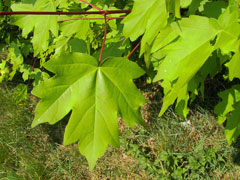
 |
|
|
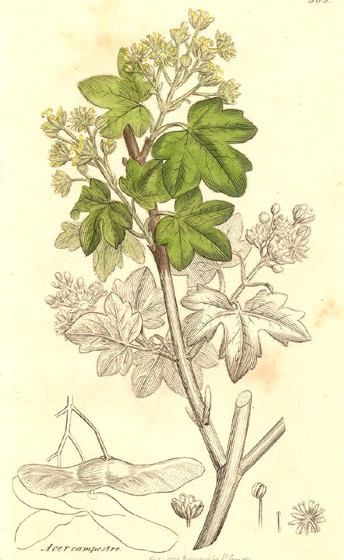 |
| http://commons.wikimedia.org/wiki/File:Acer_campestreAA.jpg |
Translate this page:
Summary
Bloom Color: Green.
Main Bloom Time: Early spring, Late spring, Mid spring. Form: Rounded.
Physical Characteristics

 Acer campestre is a deciduous Tree growing to 15 m (49ft 3in) at a fast rate.
See above for USDA hardiness. It is hardy to UK zone 4 and is not frost tender. It is in flower from May to June, and the seeds ripen from September to October. The species is monoecious (individual flowers are either male or female, but both sexes can be found on the same plant) and is pollinated by Insects.
It is noted for attracting wildlife.
Suitable for: light (sandy), medium (loamy) and heavy (clay) soils and can grow in heavy clay soil. Suitable pH: mildly acid, neutral and basic (mildly alkaline) soils and can grow in very alkaline soils.
It can grow in semi-shade (light woodland) or no shade. It prefers moist soil. The plant can tolerates strong winds but not maritime exposure.
It can tolerate atmospheric pollution.
UK Hardiness Map
US Hardiness Map
Synonyms
Plant Habitats
Woodland Garden Secondary; Dappled Shade; Hedge;
Edible Uses
The sap contains a certain amount of sugar and can either be used as a drink, or can be concentrated into a syrup by boiling off the water[4]. The concentration of sugar is considerably lower than in the sugar maples (A. saccharum). The syrup is used as a sweetener on many foods. The tree trunk is tapped in the early spring, the sap flowing better on warm sunny days following a frost. The best sap production comes from cold-winter areas with continental climates.
References More on Edible Uses
Medicinal Uses
Plants For A Future can not take any responsibility for any adverse effects from the use of plants. Always seek advice from a professional before using a plant medicinally.
Anticholesterolemic Astringent
The bark is astringent and slightly anticholesterolemic[7]. A decoction has been used to bathe sore eyes[7]. The bark should be sun-dried and then stored in a dry place until required[7].
References More on Medicinal Uses
The Bookshop: Edible Plant Books
Our Latest books on Perennial Plants For Food Forests and Permaculture Gardens in paperback or digital formats.

Edible Tropical Plants
Food Forest Plants for Hotter Conditions: 250+ Plants For Tropical Food Forests & Permaculture Gardens.
More

Edible Temperate Plants
Plants for Your Food Forest: 500 Plants for Temperate Food Forests & Permaculture Gardens.
More

More Books
PFAF have eight books available in paperback and digital formats. Browse the shop for more information.
Shop Now
Other Uses
Charcoal Fuel Hedge Hedge Preservative Wood
The leaves are packed around apples, rootcrops etc to help preserve them[18, 20]. A fast growing plant and bearing clipping well, it makes an excellent clipped hedge and can also be used as part of a native wildlife hedge where it is only trimmed every 3 - 4 years[200, K]. It has also been used in topiary[200]. Wood - fine-grained, tough, elastic, hard to split, takes a high polish and is seldom attacked by insects. Trees are seldom large enough to supply much usable timber, but when available it is much valued by cabinet makers[4, 7, 13, 46, 115]. It is also used for cups bowls etc[115]. The wood of the roots is often knotted and is valued for small objects of cabinet work[4]. The wood is an excellent fuel[4]. A charcoal made from the wood is a good fuel[4, 115].
Special Uses
Attracts Wildlife Hedge Hedge
References More on Other Uses
Cultivation details
Landscape Uses:Firewood, Pollard, Screen, Standard, Superior hedge, Specimen, Street tree. Of easy cultivation, it prefers a good moist well-drained soil[11] in a sunny position but tolerates some shade[11, 200]. Does well on chalky soils, tolerating a pH as high as 8, but becoming a shrub in such conditions[186]. Does not thrive in soils with a pH much below 6[186]. Grows well in heavy clay soils. Tolerates atmospheric pollution[200]. Growth is fast once the trees are established, but this later slows down and trees take about 50 years to reach maturity[186]. Frequently found as a shrub in light woodland, especially under oak. It is one of the first trees to colonize chalk grassland[186]. The field maple is a bad companion plant, inhibiting the growth of nearby plants[18, 20]. A good bee plant[7]. This species has often been coppiced in the past for its wood[17]. Trees produce seed in about 10 years from sowing[98]. Special Features:
Not North American native, Inconspicuous flowers or blooms.
References Carbon Farming Information and Carbon Sequestration Information
Temperature Converter
Type a value in the Celsius field to convert the value to Fahrenheit:
Fahrenheit:
The PFAF Bookshop
Plants For A Future have a number of books available in paperback and digital form. Book titles include Edible Plants, Edible Perennials, Edible Trees,Edible Shrubs, Woodland Gardening, and Temperate Food Forest Plants. Our new book is Food Forest Plants For Hotter Conditions (Tropical and Sub-Tropical).
Shop Now
Plant Propagation
Seed - best sown as soon as it is ripe in a cold frame, it usually germinates in the following spring. Pre-soak stored seed for 24 hours and then stratify for 2 - 4 months at 1 - 8°c. It can be slow to germinate. The seed can be harvested 'green' (when it has fully developed but before it has dried and produced any germination inhibitors) and sown immediately. It should germinate in late winter. If the seed is harvested too soon it will produce very weak plants or no plants at all[80, 113]. When large enough to handle, prick the seedlings out into individual pots and grow them on until they are 20cm or more tall before planting them out in their permanent positions. Layering, which takes about 12 months, is successful with most species in this genus. Cuttings of young shoots in June or July. The cuttings should have 2 - 3 pairs of leaves, plus one pair of buds at the base. Remove a very thin slice of bark at the base of the cutting, rooting is improved if a rooting hormone is used. The rooted cuttings must show new growth during the summer before being potted up otherwise they are unlikely to survive the winter.
Other Names
If available other names are mentioned here
Native Plant Search
Search over 900 plants ideal for food forests and permaculture gardens. Filter to search native plants to your area. The plants selected are the plants in our book 'Plants For Your Food Forest: 500 Plants for Temperate Food Forests and Permaculture Gardens, as well as plants chosen for our forthcoming related books for Tropical/Hot Wet Climates and Mediterranean/Hot Dry Climates. Native Plant Search
Found In
Countries where the plant has been found are listed here if the information is available
Weed Potential
Right plant wrong place. We are currently updating this section.
Please note that a plant may be invasive in one area but may not in your area so it’s worth checking.
Conservation Status
IUCN Red List of Threatened Plants Status :

| Related Plants
|
| Latin Name | Common Name | Habit | Height | Hardiness | Growth | Soil | Shade | Moisture | Edible | Medicinal | Other |
| Acer acuminatum | | Tree | 6.0 |
5-9
| | LMH | SN | M | 1 | 0 | 2 |
| Acer argutum | | Tree | 8.0 |
4-8
| | LMH | SN | M | 2 | 0 | 1 |
| Acer caesium | | Tree | 15.0 |
5-9
| | LMH | SN | M | 0 | 1 | 3 |
| Acer carpinifolium | Hornbeam Maple | Shrub | 10.0 |
4-7
| S | LMH | SN | M | 2 | 0 | 1 |
| Acer circinatum | Vine Maple | Tree | 12.0 |
6-9
| S | LMH | SN | M | 2 | 1 | 2 |
| Acer crataegifolium | Hawthorn-Leaved Maple | Tree | 10.0 |
5-9
| | LMH | SN | M | 0 | 0 | 1 |
| Acer distylum | | Tree | 15.0 |
6-9
| | LMH | SN | M | 2 | 0 | 1 |
| Acer ginnala | Amur Maple | Tree | 10.0 |
3-8
| F | LMH | SN | M | 1 | 0 | 3 |
| Acer glabrum | Rock Maple, Rocky Mountain maple, Douglas maple, Greene's maple, New Mexico maple, Torrey maple | Tree | 9.0 |
3-8
| S | LMH | SN | M | 2 | 1 | 2 |
| Acer interius | Box Elder | Tree | 20.0 |
-
| | LMH | SN | M | 2 | 0 | 1 |
| Acer macrophyllum | Oregon Maple, Bigleaf maple, Oregon Maple | Tree | 30.0 |
5-9
| F | LMH | SN | M | 3 | 1 | 3 |
| Acer mono | Maple | Tree | 15.0 |
3-8
| S | LMH | SN | M | 2 | 1 | 2 |
| Acer negundo | Box Elder | Tree | 21.0 |
3-8
| F | LMH | SN | M | 3 | 1 | 3 |
| Acer oblongum | | Tree | 9.0 |
6-9
| | LMH | SN | M | 0 | 0 | 3 |
| Acer palmatum | Japanese Maple | Tree | 8.0 |
6-8
| S | LMH | SN | M | 2 | 0 | 1 |
| Acer pectinatum | Maple | Tree | 10.0 |
3-6
| S | LMH | SN | M | 0 | 0 | 2 |
| Acer pensylvanicum | Moosewood, Striped maple, Moosewood, Pennsylvania Maple | Tree | 4.5 |
3-7
| | LMH | N | M | 0 | 1 | 2 |
| Acer platanoides | Norway Maple, Harlequin Maple | Tree | 21.0 |
3-7
| F | LMH | SN | M | 2 | 0 | 3 |
| Acer pseudoplatanus | Sycamore, Great Maple, Scottish Maple, Planetree Maple | Tree | 30.0 |
4-7
| F | LMH | SN | M | 2 | 1 | 4 |
| Acer rubrum | Red Maple, Drummond's maple, Swamp Maple | Tree | 30.0 |
4-10
| F | LMH | SN | M | 3 | 1 | 3 |
| Acer saccharinum | Silver Maple, River Maple, Soft Maple | Tree | 30.0 |
3-9
| F | LMH | SN | M | 3 | 1 | 4 |
| Acer saccharum | Sugar Maple, Florida Maple, Hard Maple, Rock Maple | Tree | 30.0 |
4-8
| S | LMH | SN | M | 4 | 2 | 4 |
| Acer saccharum grandidentatum | Big-Tooth Maple, Canyon Maple, Rocky Mountain Sugar Maple | Tree | 12.0 |
5-8
| | LMH | SN | M | 4 | 0 | 3 |
| Acer saccharum nigrum | Black Maple | Tree | 25.0 |
4-6
| S | LMH | SN | M | 4 | 1 | 2 |
| Acer spicatum | Mountain Maple | Tree | 10.0 |
3-6
| S | LMH | N | M | 2 | 2 | 3 |
| Acer sterculiaceum | | Tree | 6.0 |
7-10
| | LMH | SN | M | 0 | 0 | 2 |
| Acer tataricum | Tatarian Maple | Tree | 9.0 |
3-7
| M | LMH | SN | M | 2 | 0 | 1 |
| Acer truncatum | Shantung Maple, Purpleblow Maple | Tree | 8.0 |
3-8
| S | LMH | SN | M | 1 | 0 | 1 |
| Acer ukurunduense caudatum | | Tree | 20.0 |
-
| S | LMH | SN | M | 1 | 0 | 3 |
|
|
Growth: S = slow M = medium F = fast. Soil: L = light (sandy) M = medium H = heavy (clay). pH: A = acid N = neutral B = basic (alkaline). Shade: F = full shade S = semi-shade N = no shade. Moisture: D = dry M = Moist We = wet Wa = water.

Expert comment
Author
L.
Botanical References
1117200
Links / References
For a list of references used on this page please go here
Readers comment
© 2010, Plants For A Future. Plants For A Future is a charitable company limited by guarantee, registered in England and Wales. Charity No. 1057719, Company No. 3204567.