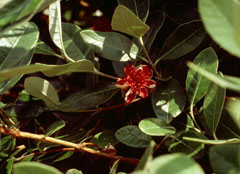
 |
|
(c) ken Fern, Plants For A Future 2010 |
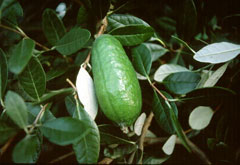 |
| (c) ken Fern, Plants For A Future 2010 |
Translate this page:
Summary
Bloom Color: Red, White.
Main Bloom Time: Early spring, Late spring, Mid spring. Form: Rounded, Spreading or Horizontal, Upright or erect.
Physical Characteristics

 Acca sellowiana is an evergreen Shrub growing to 3 m (9ft) by 3 m (9ft) at a slow rate.
See above for USDA hardiness. It is hardy to UK zone 8 and is not frost tender. It is in leaf all year, in flower in July, and the seeds ripen from October to January. The species is hermaphrodite (has both male and female organs) and is pollinated by Insects. The plant is not self-fertile.
Suitable for: light (sandy), medium (loamy) and heavy (clay) soils and prefers well-drained soil. Suitable pH: mildly acid, neutral and basic (mildly alkaline) soils. It cannot grow in the shade. It prefers dry or moist soil and can tolerate drought. The plant can tolerate maritime exposure.
UK Hardiness Map
US Hardiness Map
Synonyms
Acca sellowiana. Orthostemon sellowianus.
Plant Habitats
Woodland Garden Sunny Edge; Hedge; South Wall. By. West Wall. By.
Edible Uses
Edible Parts: Flowers Fruit
Edible Uses:
Fruit - raw or cooked[3, 11, 183]. A delicious aromatic taste, somewhat like a cross between a pineapple and a strawberry[183]. The fruit is best eaten raw but it can also be made into pies, cakes, puddings, jams, jellies etc[183]. Fruits can suffer damage from autumn frosts, though the flavour develops better at low temperatures[200]. The fruit is up to 7.5cm long[200]. Flowers - raw[3, 160, 166]. The petals are sweet, crisp and delicious, they taste more like a fruit than many fruits[K]. They should be harvested just after they begin to soften[183] (not sure that I agree with this last sentence[K])
References More on Edible Uses
Medicinal Uses
Plants For A Future can not take any responsibility for any adverse effects from the use of plants. Always seek advice from a professional before using a plant medicinally.
None known
References More on Medicinal Uses
The Bookshop: Edible Plant Books
Our Latest books on Perennial Plants For Food Forests and Permaculture Gardens in paperback or digital formats.
Edible Tropical Plants
Food Forest Plants for Hotter Conditions: 250+ Plants For Tropical Food Forests & Permaculture Gardens.
More
Edible Temperate Plants
Plants for Your Food Forest: 500 Plants for Temperate Food Forests & Permaculture Gardens.
More
More Books
PFAF have eight books available in paperback and digital formats. Browse the shop for more information.
Shop Now
Other Uses
Hedge Hedge
Although not very cold hardy in Britain, it resists maritime exposure and can be grown as a shelter hedge in mild maritime areas[200, K].
Special Uses
Hedge Hedge
References More on Other Uses
Cultivation details
Landscape Uses:Pest tolerant, Hedge, Massing, Screen, Standard, Seashore. Prefers a light loamy well-drained soil[11, 200], requiring a warm sunny position[182]. Prefers light shade[202]. Succeeds in any reasonably good soil, even chalk[1, 182]. Dislikes extreme alkalinity[202]. Tolerates drought and salt winds[200]. A very ornamental plant[1], it is only hardy in the milder areas of Britain. It grows very well on a west-facing wall at Kew where it often produces fruits, though these do not always ripen[K]. A very good crop of fruit was produced on this plant after the cool summer of 1998, these were not quite ripe at the end of October, but they ripened in storage[K]. Plants have also succeeded in Norfolk and in Scotland when grown against a sunny wall, though some extra protection might be required in very cold winters[219]. Succeeds as a free-standing shrub in Cornwall[1, 59]. Tolerates temperatures down to between -12 and -15°c[184] when the plant is fully dormant[200]. Occasionally, and more frequently, being cultivated for its edible fruit in sub-tropical zones[3, 61], there are some named varieties[183]. 'Apollo' and 'Mammoth' are cultivars noted for their fruiting propensity[182]. 'Smith' fruits well in the Pacific Northwest and so might be suitable for the mild areas of Britain[183, K]. Fruits only ripen outdoors in Britain in hot summers[3]. Plants rarely set fruit in Britain, perhaps they are self-sterile[11]. Some cultivars are self-fertile whilst others require cross-pollination[183]. Special Features:Not North American native, Attractive flowers or blooms.
References Carbon Farming Information and Carbon Sequestration Information
Temperature Converter
Type a value in the Celsius field to convert the value to Fahrenheit:
Fahrenheit:
The PFAF Bookshop
Plants For A Future have a number of books available in paperback and digital form. Book titles include Edible Plants, Edible Perennials, Edible Trees,Edible Shrubs, Woodland Gardening, and Temperate Food Forest Plants. Our new book is Food Forest Plants For Hotter Conditions (Tropical and Sub-Tropical).
Shop Now
Plant Propagation
Seed - sow spring in a greenhouse. Rinse the seed before sowing to ensure there is no fruit flesh remaining since this can inhibit germination. The seed usually germinates in 3 - 6 weeks at 15°c[3]. Prick out the seedlings into individual pots as soon as they are large enough to handle. Grow on for at least the first winter in a greenhouse and plant out in late spring or early summer after the last expected frosts. Give the plants some protection for their first winter outdoors. Cuttings of half-ripe wood, 5 - 7 cm with a heel, July/August in a frame. Slow to root[K], but you eventually get a good percentage take[78].
Other Names
If available other names are mentioned here
Goiaba-do-campo, Goiaba serrana, Goiaba verde, Goiabo abacaxi, Goiabeira-serrana, Guayaba chilena, Guayabo chico, Guayabo grande, Jambu nanas,
Native Plant Search
Search over 900 plants ideal for food forests and permaculture gardens. Filter to search native plants to your area. The plants selected are the plants in our book 'Plants For Your Food Forest: 500 Plants for Temperate Food Forests and Permaculture Gardens, as well as plants chosen for our forthcoming related books for Tropical/Hot Wet Climates and Mediterranean/Hot Dry Climates. Native Plant Search
Found In
Countries where the plant has been found are listed here if the information is available
Africa, Argentina, Asia, Australia, Azerbaijan, Bahamas, Brazil*, Britain, Central America, Chile, China, Cook Islands, Costa Rica, Cuba, East Africa, Europe, France, Georgia, Hawaii, Himalayas, India, Indochina, Indonesia, Israel, Italy, Jamaica, Kenya, Madagascar, Mexico, New Zealand, North America, Pacific, Papua New Guinea, PNG, Paraguay, Philippines, Portugal, Russia, SE Asia, South America, Spain, Switzerland, Tasmania, Uruguay, USA,
Weed Potential
Right plant wrong place. We are currently updating this section.
Please note that a plant may be invasive in one area but may not in your area so it’s worth checking.
Conservation Status
IUCN Red List of Threatened Plants Status :

| Related Plants
|
| Latin Name | Common Name | Habit | Height | Hardiness | Growth | Soil | Shade | Moisture | Edible | Medicinal | Other |
| Asarum europaeum | Asarabacca, European Wild Ginger | Perennial | 0.1 |
4-8
| S | LMH | FS | M | 0 | 2 | 3 |
| Asarum shuttleworthii | Asarabacca, Mottled Wild Ginger | Perennial | 0.1 |
5-9
| F | LMH | FS | M | 2 | 0 | 2 |
| Atriplex saccaria | Sack Saltbush | Annual | 0.3 |
-
| | LM | N | DM | 2 | 0 | |
| Atriplex semibaccata | Australian Saltbush. Australian saltbush, Creeping saltbush | Shrub | 0.5 |
9-11
| F | LMH | N | DM | 2 | 0 | 3 |
| Capsicum baccatum | Locoto, Aji | Perennial | 2.0 |
8-11
| | LMH | N | M | 3 | 3 | 1 |
| Gaylussacia baccata | Black Huckleberry | Shrub | 1.0 |
5-9
| | LMH | SN | DM | 4 | 1 | 0 |
| Malus baccata | Chinese Crab, Siberian crab apple | Tree | 15.0 |
2-7
| M | LMH | SN | M | 2 | 1 | 2 |
| Malus baccata mandschurica | Manchurian Apple | Tree | 7.0 |
0-0
| | LMH | SN | M | 4 | 0 | 2 |
| Petiveria alliacea | Guinea Hen Weed | Perennial | 1.0 |
9-12
| F | LMH | SN | M | 0 | 4 | 3 |
| Phytolacca acinosa | Indian Poke | Perennial | 1.5 |
7-10
| | LMH | SN | M | 2 | 3 | 1 |
| Phytolacca americana | Pokeweed, American pokeweed, Garnet, Pigeon Berry, Poke | Perennial | 2.0 |
4-8
| F | LMH | SN | M | 3 | 3 | 2 |
| Phytolacca dioica | Bella Sombra | Tree | 4.0 |
8-11
| | LMH | SN | M | 2 | 0 | 1 |
| Phytolacca dodecandra | Endod, Pokeberry | Shrub | 4.0 |
10-12
| M | LMH | FSN | DM | 2 | 3 | 4 |
| Phytolacca esculenta | | Perennial | 1.0 |
5-9
| | LMH | SN | M | 2 | 2 | 1 |
| Salacca zalacca | Salak Palm, Snake Palm | Shrub | 4.0 |
10-12
| F | LM | SN | M | 5 | 0 | 3 |
| Tacca leontopetaloides | Polynesian Arrowroot, Pia | Perennial | 1.0 |
8-12
| F | LMH | SN | M | 4 | 2 | 3 |
| Taxus baccata | Yew, English yew, Common Yew | Tree | 15.0 |
5-7
| S | LMH | FSN | DM | 3 | 4 | 4 |
| Vaccaria hispanica | Cow Cockle, Cow soapwort | Annual | 0.6 |
0-0
| | LMH | N | M | 1 | 3 | 0 |
| Vicia cracca | Tufted Vetch, Bird vetch, Cow vetch | Perennial Climber | 1.8 |
4-8
| | LMH | SN | M | 1 | 1 | 3 |
| Yucca baccata | Spanish Bayonet, Banana yucca, Blue Yucca, Spanish Yucca | Shrub | 0.9 |
6-11
| S | LMH | N | DM | 4 | 1 | 5 |
|
Growth: S = slow M = medium F = fast. Soil: L = light (sandy) M = medium H = heavy (clay). pH: A = acid N = neutral B = basic (alkaline). Shade: F = full shade S = semi-shade N = no shade. Moisture: D = dry M = Moist We = wet Wa = water.

Expert comment
Author
(O.Berg.)Burret.
Botanical References
11200
Links / References
For a list of references used on this page please go here
Readers comment