 |
|
|
 |
| http://commons.wikimedia.org/wiki/User:Mbc |
Translate this page:
Summary
Form: Upright or erect.
Physical Characteristics

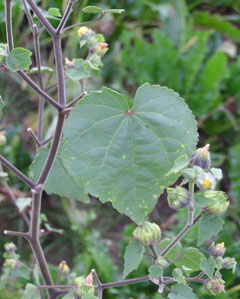
 Abutilon theophrasti is a ANNUAL growing to 1 m (3ft 3in).
See above for USDA hardiness. It is hardy to UK zone 4. It is in leaf from May to October, in flower from July to August. The species is hermaphrodite (has both male and female organs).
Suitable for: light (sandy), medium (loamy) and heavy (clay) soils and prefers well-drained soil. Suitable pH: mildly acid, neutral and basic (mildly alkaline) soils and can grow in very alkaline soils.
It can grow in semi-shade (light woodland) or no shade. It prefers dry or moist soil.
UK Hardiness Map
US Hardiness Map
Synonyms
A. avicennae. Gaertn.
Plant Habitats
Cultivated Beds;
Edible Uses
Edible Parts: Fruit Oil Seed
Edible Uses: Oil
Seeds - raw or cooked. They can be eaten raw when they are under-ripe[179]. The ripe seed is dried and ground into a powder then used in soups, bread etc[177, 178]. It is washed first to remove any bitterness[179]. The seed contains about 17.4% protein, 16% fat, 33.8% carbohydrate, 4.4% ash[179]. Unripe fruit - raw[177]. This is really more of a seedpod[K].
References More on Edible Uses
| Composition
|
| Figures in grams (g) or miligrams (mg) per 100g of food.
|
|
|
Seed (Fresh weight)
|
|
- 0 Calories per 100g
- Water : 0%
- Protein: 17.4g; Fat: 16g; Carbohydrate: 33.8g; Fibre: 0g; Ash: 4.4g;
- Minerals - Calcium: 0mg; Phosphorus: 0mg; Iron: 0mg; Magnesium: 0mg; Sodium: 0mg; Potassium: 0mg; Zinc: 0mg;
- Vitamins - A: 0mg; Thiamine (B1): 0mg; Riboflavin (B2): 0mg; Niacin: 0mg; B6: 0mg; C: 0mg;
- Reference: [ ]
- Notes:
|
|
Medicinal Uses
Plants For A Future can not take any responsibility for any adverse effects from the use of plants. Always seek advice from a professional before using a plant medicinally.
Astringent Demulcent Diuretic Dysentery Emollient Laxative Ophthalmic Poultice
Stomachic Urinary
Ophthalmic. Used in the treatment of dysentery and opacity of the cornea[145, 178]. The leaves contain 0.01% rutin and are used as a demulcent[240]. A tea made from the dried leaves is used in the treatment of dysentery and fevers[222]. A poultice of the leaves is applied to ulcers[222]. The bark is astringent and diuretic[240]. A tea made from the dried root is used in the treatment of dysentery and urinary incontinence[222]. It is also used to treat fevers[240]. The seed is powdered and eaten in the treatment of dysentery, stomach-aches etc[222]. It is demulcent, diuretic, emollient, laxative and stomachic[218].
References More on Medicinal Uses
The Bookshop: Edible Plant Books
Our Latest books on Perennial Plants For Food Forests and Permaculture Gardens in paperback or digital formats.

Edible Tropical Plants
Food Forest Plants for Hotter Conditions: 250+ Plants For Tropical Food Forests & Permaculture Gardens.
More

Edible Temperate Plants
Plants for Your Food Forest: 500 Plants for Temperate Food Forests & Permaculture Gardens.
More

More Books
PFAF have eight books available in paperback and digital formats. Browse the shop for more information.
Shop Now
Other Uses
Fibre Oil Paper
A fibre obtained from the stems is used as a jute substitute[123, 169]. It is coarse but flexible and strong[169, 171]. It is also used in rope-making[46, 61]. It takes dyes well[171]. The fibre is also used for making paper, the stems are harvested in the summer, the leaves removed and the stems steamed in order to remove the fibres[189]. The seeds contain about 19% of a semi-drying oil[240].
Special Uses
References More on Other Uses
Cultivation details
Requires full sun or part day shade and a fertile well-drained soil[200]. Tolerates a pH in the range 5 to 8.2. This species is cultivated for its fibre in China and Russia where it succeeds as far north as latitude 56°n in W. Siberia[61, 123]. It is hardier and more disease-resistant than Jute (Corchorus spp.)[123]. Introduced to N. America in the eighteenth century, it has become a pestilential weed in many parts of the country[207]. Special Features:Invasive.
References Carbon Farming Information and Carbon Sequestration Information
Temperature Converter
Type a value in the Celsius field to convert the value to Fahrenheit:
Fahrenheit:
The PFAF Bookshop
Plants For A Future have a number of books available in paperback and digital form. Book titles include Edible Plants, Edible Perennials, Edible Trees,Edible Shrubs, Woodland Gardening, and Temperate Food Forest Plants. Our new book is Food Forest Plants For Hotter Conditions (Tropical and Sub-Tropical).
Shop Now
Plant Propagation
Seed - sow early April in a greenhouse. Germination should take place within 2 - 3 weeks. When large enough to handle, prick the seedlings out into individual pots and plant them out in May or June, after the last expected frosts. An outdoor sowing in April to early May in situ could also be tried, especially in those areas with warm summers.
Other Names
If available other names are mentioned here
Native Plant Search
Search over 900 plants ideal for food forests and permaculture gardens. Filter to search native plants to your area. The plants selected are the plants in our book 'Plants For Your Food Forest: 500 Plants for Temperate Food Forests and Permaculture Gardens, as well as plants chosen for our forthcoming related books for Tropical/Hot Wet Climates and Mediterranean/Hot Dry Climates. Native Plant Search
Found In
Countries where the plant has been found are listed here if the information is available
Weed Potential
Right plant wrong place. We are currently updating this section.
Please note that a plant may be invasive in one area but may not in your area so it’s worth checking.
Colorado: C list (noxious weeds).
Iowa: Secondary noxious weed.
Oregon: ”B” designated weed/Quarantine.
Washington: Class A noxious weed, Noxious weed seed and plant quarantine. [1c]
Conservation Status
IUCN Red List of Threatened Plants Status : This taxon has not yet been assessed.

Growth: S = slow M = medium F = fast. Soil: L = light (sandy) M = medium H = heavy (clay). pH: A = acid N = neutral B = basic (alkaline). Shade: F = full shade S = semi-shade N = no shade. Moisture: D = dry M = Moist We = wet Wa = water.

Expert comment
Author
Medik.
Botanical References
200
Links / References
For a list of references used on this page please go here
Readers comment