 |
|
http://en.wikipedia.org/wiki/User_talk:Wsiegmund |
 |
|
Translate this page:
Summary
Physical Characteristics

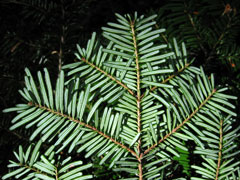
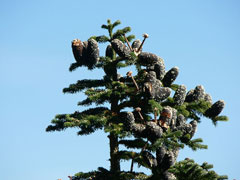
 Abies amabilis is an evergreen Tree growing to 30 m (98ft) by 5 m (16ft) at a slow rate.
See above for USDA hardiness. It is hardy to UK zone 5. It is in leaf all year, and the seeds ripen in October. The species is monoecious (individual flowers are either male or female, but both sexes can be found on the same plant) and is pollinated by Wind.
Suitable for: light (sandy), medium (loamy) and heavy (clay) soils and can grow in heavy clay soil. Suitable pH: mildly acid and neutral soils. It can grow in full shade (deep woodland) semi-shade (light woodland) or no shade. It prefers moist soil. The plant is not wind tolerant.
It cannot tolerate atmospheric pollution.
UK Hardiness Map
US Hardiness Map
Synonyms
Plant Habitats
Woodland Garden Canopy;
Edible Uses
Edible Parts: Inner bark Shoots
Edible Uses: Gum Tea
Young shoot tips are used as a substitute for tea[177, 183]. The pitch obtained from the bark can be hardened (probably by immersing it in cold water[K]) and used as a chewing gum[257]. Inner bark[257]. No further information is given, but inner bark can be dried, ground into a powder and then used with grain flours etc to make bread and other preparations[257].
References More on Edible Uses
Medicinal Uses
Plants For A Future can not take any responsibility for any adverse effects from the use of plants. Always seek advice from a professional before using a plant medicinally.
This plant was used quite widely by native North American Indians. An infusion of the bark was used as a tonic and to treat stomach ailments, TB, haemorrhoids and various minor complaints[257]. The pitch, or resin, was also used to treat colds, sore throats etc[257]. The bark of this tree contains blisters that are filled with a resin called 'Canadian Balsam'[226]. Although the report does not mention the uses of this resin, it can almost certainly be used in the same ways as the resin of A. balsamea, as detailed below:- The resin obtained from this tree (see 'Uses notes' below) has been used throughout the world and is a very effective antiseptic and healing agent. It is used as a healing and analgesic protective covering for burns, bruises, wounds and sores[213, 222, 226]. It is also used to treat sore nipples[213] and is said to be one of the best curatives for a sore throat[245]. The resin is also antiscorbutic, diuretic, stimulant and tonic[4, 171, 222]. It is used internally in propriety mixtures to treat coughs and diarrhoea, though taken in excess it is purgative[238]. A warm liquid of the gummy sap was drunk as a treatment for gonorrhoea[212]. A tea made from the leaves is antiscorbutic[4, 171]. It is used in the treatment of coughs, colds and fevers[222]. The leaves and young shoots are best harvested in the spring and dried for later use[238].
References More on Medicinal Uses
The Bookshop: Edible Plant Books
Our Latest books on Perennial Plants For Food Forests and Permaculture Gardens in paperback or digital formats.

Edible Tropical Plants
Food Forest Plants for Hotter Conditions: 250+ Plants For Tropical Food Forests & Permaculture Gardens.
More

Edible Temperate Plants
Plants for Your Food Forest: 500 Plants for Temperate Food Forests & Permaculture Gardens.
More

More Books
PFAF have eight books available in paperback and digital formats. Browse the shop for more information.
Shop Now
Other Uses
Gum Wood
The boughs are fragrant and can be hung in the home as an air freshener[257]. Wood - hard, light, not strong, close grained, not very durable. It is used for framing small buildings but is not strong enough for larger buildings. It is also used for crates, pulp etc[46, 61, 82, 226, 229]. This tree yields the resin 'Canadian Balsam'[226]. The report does not mention the uses of this balsam, but the following are the ways that it is used when obtained from A. balsamea:- The balsamic resin 'Balm of Gilead'[11, 46] or 'Canada Balsam' according to other reports[64, 226, 238] is obtained during July and August from blisters in the bark or by cutting pockets in the wood[222]. Another report says that it is a turpentine[171]. It is used medicinally and in dentistry, also in the manufacture of glues, candles and as a cement for microscopes and slides - it has a high refractive index resembling that of glass[11, 46, 64, 82, 222, 226, 238]. The average yield is about 8 - 10 oz per tree[171]. The resin is also a fixative in soaps and perfumery[171, 238].
Special Uses
References More on Other Uses
Cultivation details
Requires a good moist but not water-logged soil in a sheltered position[1]. Grows well in heavy clay soils. Plants are very shade tolerant[11, 81] but growth is slower in dense shade[81]. Intolerant of atmospheric pollution[1]. Prefers slightly acid conditions down to a pH of about 5[200]. Prefers growing on a north-facing slope[200]. Trees are somewhat shallow rooted and are therefore susceptible to strong winds[229]. Grows best in the Perthshire valleys of Scotland[11]. It does very well on glacial moraines in Scotland[81]. When grown in an open position, the tree clothes itself to the ground with gracefully drooping branches, though on the whole, this species does not grow well in Britain[11]. Trees have been of variable growth in this country and seem to be short-lived[185]. The best and fastest growing specimens are to be found in the north and far west of the country[185]. Growth in girth can be very quick, 1.8 metres in 35 years has been recorded[185]. Trees should be planted into their permanent positions when they are quite small, between 30 and 90cm in height. Larger trees will check badly and hardly put on any growth for several years. This also badly affects root development and wind resistance[200]. The crushed leaves have an odour like orange peel[11]. Plants are strongly outbreeding, self-fertilized seed usually grows poorly[200]. They hybridize freely with other members of this genus[200]. This species is often confused with A. nordmanniana[11]. A very ornamental plant[1]. Trees are sometimes grown as 'Christmas trees'[200]. Plants are susceptible to injury by aphis[11].
References Carbon Farming Information and Carbon Sequestration Information
Temperature Converter
Type a value in the Celsius field to convert the value to Fahrenheit:
Fahrenheit:
The PFAF Bookshop
Plants For A Future have a number of books available in paperback and digital form. Book titles include Edible Plants, Edible Perennials, Edible Trees,Edible Shrubs, Woodland Gardening, and Temperate Food Forest Plants. Our new book is Food Forest Plants For Hotter Conditions (Tropical and Sub-Tropical).
Shop Now
Plant Propagation
Seed - sow early February in a greenhouse or outdoors in March[78]. Germination is often poor, usually taking about 6 - 8 weeks[78]. Stratification is said to produce a more even germination so it is probably best to sow the seed in a cold frame as soon as it is ripe in the autumn[80, 113]. The seed remains viable for up to 5 years if it is well stored[113]. When large enough to handle, prick the seedlings out into individual pots and grow them on for at least their first winter in pots. Plant them out into their permanent positions in late spring or early summer, after the last expected frosts. Alternatively, if you have sufficient seed, it is possible to sow in an outdoor seedbed. One report says that it is best to grow the seedlings on in the shade at a density of about 550 plants per square metre[78] whilst another report says that they are best grown on in a sunny position[80].
Other Names
If available other names are mentioned here
Native Plant Search
Search over 900 plants ideal for food forests and permaculture gardens. Filter to search native plants to your area. The plants selected are the plants in our book 'Plants For Your Food Forest: 500 Plants for Temperate Food Forests and Permaculture Gardens, as well as plants chosen for our forthcoming related books for Tropical/Hot Wet Climates and Mediterranean/Hot Dry Climates. Native Plant Search
Found In
Countries where the plant has been found are listed here if the information is available
Weed Potential
Right plant wrong place. We are currently updating this section.
Please note that a plant may be invasive in one area but may not in your area so it’s worth checking.
Conservation Status
IUCN Red List of Threatened Plants Status :

| Related Plants
|
| Latin Name | Common Name | Habit | Height | Hardiness | Growth | Soil | Shade | Moisture | Edible | Medicinal | Other |
| Abies alba | Silver Fir, Christmas Tree Fir, European Silver Fir, Silver | Tree | 45.0 |
5-8
| F | LMH | FSN | M | 2 | 3 | 4 |
| Abies balsamea | Balsam Fir | Tree | 15.0 |
3-6
| S | LMH | FSN | M | 3 | 5 | 3 |
| Abies cephalonica | Grecian Fir | Tree | 36.0 |
4-8
| M | LMH | FSN | M | 0 | 0 | 2 |
| Abies concolor | Colorado Fir, White fir | Tree | 45.0 |
3-7
| F | LMH | FSN | DM | 0 | 2 | 2 |
| Abies delavayi | | Tree | 25.0 |
6-9
| S | LMH | FSN | M | 0 | 0 | 3 |
| Abies firma | Momi Fir, Japanese Fir | Tree | 30.0 |
6-9
| M | LMH | FSN | M | 1 | 0 | 2 |
| Abies fraseri | She Balsam, Fraser fir, Southern Balsam Fir | Tree | 15.0 |
4-7
| F | LMH | FSN | M | 1 | 3 | 3 |
| Abies grandis | Grand Fir, Giant Fir, Lowland White Fir | Tree | 75.0 |
5-6
| F | LMH | FSN | M | 2 | 2 | 3 |
| Abies homolepis | Nikko Fir | Tree | 36.0 |
4-7
| M | LMH | FSN | M | 0 | 0 | 2 |
| Abies lasiocarpa | Subalpine Fir, Alpine Fir | Tree | 25.0 |
5-6
| S | LMH | FSN | M | 2 | 2 | 2 |
| Abies magnifica | Californian Red Fir, Shasta red fir | Tree | 60.0 |
4-8
| M | LMH | FSN | M | 0 | 0 | 2 |
| Abies mariesii | | Tree | 20.0 |
5-9
| S | LMH | FSN | M | 0 | 0 | 2 |
| Abies nordmanniana | Caucasian Fir, Christmas Tree Fir, Nordmann | Tree | 50.0 |
4-6
| M | LMH | FSN | M | 0 | 0 | 2 |
| Abies pindrow | West Himalayan Fir | Tree | 30.0 |
5-7
| S | LMH | FSN | M | 0 | 0 | 2 |
| Abies procera | Noble Fir | Tree | 60.0 |
5-6
| M | LMH | FSN | M | 0 | 1 | 2 |
| Abies recurvata | | Tree | 35.0 |
5-9
| M | LMH | FSN | M | 0 | 0 | 2 |
| Abies religiosa | Sacred Fir | Tree | 40.0 |
7-10
| F | LMH | FSN | M | 0 | 1 | 3 |
| Abies sachalinensis | Sakhalin Fir | Tree | 30.0 |
3-6
| S | LMH | FSN | M | 0 | 0 | 2 |
| Abies sibirica | Siberian Fir | Tree | 30.0 |
-
| | LMH | FSN | M | 0 | 1 | 3 |
| Abies spectabilis | Himalayan Fir | Tree | 30.0 |
6-9
| S | LMH | FSN | M | 0 | 2 | 3 |
| Abies squamata | Flaky Fir | Tree | 30.0 |
5-9
| S | LMH | FSN | DM | 0 | 0 | 2 |
| Abies veitchii | Veitch Fir, Christmastree | Tree | 25.0 |
3-7
| F | LMH | FSN | M | 0 | 0 | 2 |
| Abies veitchii sikokiana | | Tree | 30.0 |
3-7
| | LMH | FSN | M | 0 | 0 | 2 |
| Picea abies | Norway Spruce | Tree | 30.0 |
2-7
| F | LMH | N | MWe | 2 | 1 | 4 |
|
Growth: S = slow M = medium F = fast. Soil: L = light (sandy) M = medium H = heavy (clay). pH: A = acid N = neutral B = basic (alkaline). Shade: F = full shade S = semi-shade N = no shade. Moisture: D = dry M = Moist We = wet Wa = water.

Expert comment
Author
Douglas. ex Forbes.
Botanical References
1160200
Links / References
For a list of references used on this page please go here
Readers comment
| Add a comment |
|
If you have important information about this plant that may help other users please add a comment or link below. Only comments or links that are felt to be directly relevant to a plant will be included. If you think a comment/link or information contained on this page is inaccurate or misleading we would welcome your feedback at [email protected]. If you have questions about a plant please use the Forum on this website as we do not have the resources to answer questions ourselves.
* Please note: the comments by website users are not necessarily those held by PFAF and may give misleading or inaccurate information.
To leave a comment please Register or login here All comments need to be approved so will not appear immediately.
|
|