 |
|
http://commons.wikimedia.org/wiki/User:Rjelves |
 |
|
Translate this page:
Summary
Physical Characteristics

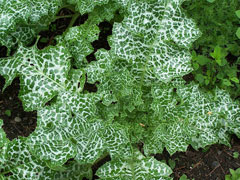
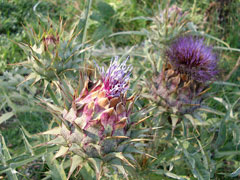
 Silybum marianum is a BIENNIAL growing to 1.2 m (4ft) by 1 m (3ft 3in) at a fast rate.
See above for USDA hardiness. It is hardy to UK zone 7 and is not frost tender. It is in leaf all year, in flower from July to September, and the seeds ripen from August to October. The species is hermaphrodite (has both male and female organs) and is pollinated by Bees.
Suitable for: light (sandy), medium (loamy) and heavy (clay) soils and prefers well-drained soil. Suitable pH: mildly acid, neutral and basic (mildly alkaline) soils and can grow in very alkaline soils.
It cannot grow in the shade. It prefers dry or moist soil. The plant can tolerates strong winds but not maritime exposure.
UK Hardiness Map
US Hardiness Map
Synonyms
Carduus lactifolius. Carduus marianus. Centaurea dalmatica. Mariana lactea
Plant Habitats
Cultivated Beds;
Edible Uses
Edible Parts: Flowers Leaves Oil Oil Root Stem
Edible Uses: Coffee Oil Oil
Root - raw or cooked[1, 2, 4, 52, 183]. A mild flavour and somewhat mucilaginous texture[K]. When boiled, the roots resemble salsify (Tragopogon hispanicus)[1, 4, 115]. Leaves - raw or cooked[1, 4, 5, 52, 89, 115]. The very sharp leaf-spines must be removed first[46, 183], which is quite a fiddly operation[K]. The leaves are quite thick and have a mild flavour when young, at this time they are quite an acceptable ingredient of mixed salads, though they can become bitter in hot dry weather[K]. When cooked they make an acceptable spinach substitute[238]. It is possible to have leaves available all year round from successional sowings[K]. Flower buds - cooked[1, 238]. A globe artichoke substitute[12, 183], they are used before the flowers open. The flavour is mild and acceptable, but the buds are quite small and even more fiddly to use than globe artichokes[K]. Stems - raw or cooked[4, 100]. They are best peeled and can be soaked to reduce the bitterness[5, 183]. Palatable and nutritious[4, 115], they can be used like asparagus or rhubarb[12] or added to salads. They are best used in spring when they are young[105]. A good quality oil is obtained from the seeds[4]. The roasted seed is a coffee substitute[21, 46, 61, 183].
References More on Edible Uses
Medicinal Uses
Plants For A Future can not take any responsibility for any adverse effects from the use of plants. Always seek advice from a professional before using a plant medicinally.
Astringent Bitter Cholagogue Diaphoretic Diuretic Emetic Emmenagogue Hepatic
Homeopathy Stimulant Stomachic Tonic
Milk Thistle has a long history of use in the West as a remedy for depression and liver problems[254]. Recent research has confirmed that it has a remarkable ability to protect the liver from damage resulting from alcoholic and other types of poisoning[254]. The whole plant is astringent, bitter, cholagogue, diaphoretic, diuretic, emetic, emmenagogue, hepatic, stimulant, stomachic and tonic[4, 21, 160, 165, 238]. It is used internally in the treatment of liver and gall bladder diseases, jaundice, cirrhosis, hepatitis and poisoning[238]. The plant is harvested when in flower and dried for later use[238]. Silymarin, an extract from the seed, acts on the membranes of the liver cells preventing the entry of virus toxins and other toxic compounds and thus preventing damage to the cells[244]. It also dramatically improves liver regeneration in hepatitis, cirrhosis, mushroom poisoning and other diseases of the liver[222, 238, 254]. German research suggests that silybin (a flavonoid component of the seed) is clinically useful in the treatment of severe poisoning by Amanita mushrooms[222]. Seed extracts are produced commercially in Europe[222]. Regeneration of the liver is particularly important in the treatment of cancer since this disease is always characterized by a severely compromised and often partially destroyed liver[K]. A homeopathic remedy is obtained from equal parts of the root and the seed with its hulls still attached[4]. It is used in the treatment of liver and abdominal disorders[9]. The German Commission E Monographs, a therapeutic guide to herbal medicine, approve Silybum marianum Milk Thistle for dyspeptic complaints, liver and gallbladder complaints (see [302] for critics of commission E).
References More on Medicinal Uses
The Bookshop: Edible Plant Books
Our Latest books on Perennial Plants For Food Forests and Permaculture Gardens in paperback or digital formats.

Edible Tropical Plants
Food Forest Plants for Hotter Conditions: 250+ Plants For Tropical Food Forests & Permaculture Gardens.
More

Edible Temperate Plants
Plants for Your Food Forest: 500 Plants for Temperate Food Forests & Permaculture Gardens.
More

More Books
PFAF have eight books available in paperback and digital formats. Browse the shop for more information.
Shop Now
Other Uses
Green manure Oil Oil
A good green manure plant, producing a lot of bulk for incorporation into the soil[K].
Special Uses
References More on Other Uses
Cultivation details
Succeeds in any well-drained fertile garden soil[1, 200]. Prefers a calcareous soil[12] and a sunny position[200]. Hardy to about -15°c[200]. The blessed thistle is a very ornamental plant that was formerly cultivated as a vegetable crop[1, 61, 238]. Young plants are prone to damage from snails and slugs[200]. Plants will often self sow freely[K].
References Carbon Farming Information and Carbon Sequestration Information
Temperature Converter
Type a value in the Celsius field to convert the value to Fahrenheit:
Fahrenheit:
The PFAF Bookshop
Plants For A Future have a number of books available in paperback and digital form. Book titles include Edible Plants, Edible Perennials, Edible Trees,Edible Shrubs, Woodland Gardening, and Temperate Food Forest Plants. Our new book is Food Forest Plants For Hotter Conditions (Tropical and Sub-Tropical).
Shop Now
Plant Propagation
Seed - if sown in situ during March or April, the plant will usually flower in the summer and complete its life cycle in one growing season[K]. The seed can also be sown from May to August when the plant will normally wait until the following year to flower and thus behave as a biennial[K]. The best edible roots should be produced from a May/June sowing, whilst sowing the seed in the spring as well as the summer should ensure a supply of edible leaves all year round[K].
Other Names
If available other names are mentioned here
Native Plant Search
Search over 900 plants ideal for food forests and permaculture gardens. Filter to search native plants to your area. The plants selected are the plants in our book 'Plants For Your Food Forest: 500 Plants for Temperate Food Forests and Permaculture Gardens, as well as plants chosen for our forthcoming related books for Tropical/Hot Wet Climates and Mediterranean/Hot Dry Climates. Native Plant Search
Found In
Countries where the plant has been found are listed here if the information is available
Weed Potential
Right plant wrong place. We are currently updating this section.
Please note that a plant may be invasive in one area but may not in your area so it’s worth checking.
Conservation Status
IUCN Red List of Threatened Plants Status :
Growth: S = slow M = medium F = fast. Soil: L = light (sandy) M = medium H = heavy (clay). pH: A = acid N = neutral B = basic (alkaline). Shade: F = full shade S = semi-shade N = no shade. Moisture: D = dry M = Moist We = wet Wa = water.

Expert comment
Author
(L.)Gaertn.
Botanical References
17200
Links / References
For a list of references used on this page please go here
Readers comment