 |
|
|
 |
| http://commons.wikimedia.org/wiki/User:Rameshng |
Translate this page:
Summary
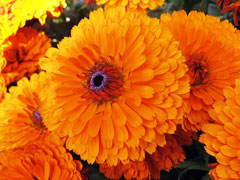
Bloom Color: Yellow.
Main Bloom Time: Early summer, Early fall, Late summer, Late spring, Mid summer, Mid fall. Form: Upright or erect.
Physical Characteristics

 Calendula officinalis is a ANNUAL growing to 0.6 m (2ft) by 0.5 m (1ft 8in) at a medium rate.
See above for USDA hardiness. It is hardy to UK zone 6 and is not frost tender. It is in flower from June to November, and the seeds ripen from August to November. The species is monoecious (individual flowers are either male or female, but both sexes can be found on the same plant) and is pollinated by Bees.
It is noted for attracting wildlife.
Suitable for: light (sandy), medium (loamy) and heavy (clay) soils, prefers well-drained soil and can grow in nutritionally poor soil. Suitable pH: mildly acid, neutral and basic (mildly alkaline) soils and can grow in very acid and very alkaline soils.
It can grow in semi-shade (light woodland) or no shade. It prefers moist soil.
UK Hardiness Map
US Hardiness Map
Synonyms
Calendula aurantiaca. Calendula eriocarpa. Calendula hydruntina. Caltha officinalis.
Plant Habitats
Cultivated Beds;
Edible Uses
Edible Parts: Flowers Leaves
Edible Uses: Colouring Tea
Leaves - raw[14, 21]. When eaten they first of all impart a viscid sweetness, followed by a strong penetrating taste of a saline nature[4]. They are very rich in vitamins and minerals and are similar to Taraxacum officinale (Dandelion) in nutritional value[179]. Fresh petals are chopped and added to salads[183]. The dried petals have a more concentrated flavour and are used as a seasoning in soups, cakes etc[183]. High in vitamins A and C[218]. An edible yellow dye is obtained from the petals[46]. A saffron substitute[21], it is used to colour and flavour rice, soups etc[2, 14, 27, 33]. It is also used as a hair rinse, adding golden tints to brown or auburn hair[201]. A tea is made from the petals and flowers, that made from the petals is less bitter[183]. There is no record of the seed being edible, but it contains up to 37% protein and 46% oil[218].
References More on Edible Uses
Medicinal Uses
Plants For A Future can not take any responsibility for any adverse effects from the use of plants. Always seek advice from a professional before using a plant medicinally.
Antiphlogistic Antiseptic Antispasmodic Aperient Astringent Cholagogue Diaphoretic Emmenagogue
Homeopathy Skin Stimulant Vulnerary Warts
Pot marigold is one of the best known and versatile herbs in Western herbal medicine and is also a popular domestic remedy[4, 254]. It is, above all, a remedy for skin problems and is applied externally to bites and stings, sprains, wounds, sore eyes, varicose veins etc[4, 254]. It is also a cleansing and detoxifying herb and is taken internally in treating fevers and chronic infections[4, 254]. Only the common deep-orange flowered variety is considered to be of medicinal value[4]. The whole plant, but especially the flowers and the leaves, is antiphlogistic, antiseptic, antispasmodic, aperient, astringent, cholagogue, diaphoretic, emmenagogue, skin, stimulant and vulnerary[4, 7, 9, 21, 46, 165, 201]. The leaves can be used fresh or dried, they are best harvested in the morning of a fine sunny day just after the dew has dried from them[4]. The flowers are also used fresh or dried, for drying they are harvested when fully open and need to be dried quickly in the shade[4]. A tea of the petals tones up the circulation and, taken regularly, can ease varicose veins[201]. An application of the crushed stems to corns and warts will soon render them easily removable[7]. The leaves, blossoms and buds are used to make a homeopathic remedy[232]. It is used internally in order to speed the healing of wounds[232]. The German Commission E Monographs, a therapeutic guide to herbal medicine, approve Calendula officinalis for inflammation of the mouth and pharynx (throat), wounds and burns(see [302] for critics of commission E).
References More on Medicinal Uses
The Bookshop: Edible Plant Books
Our Latest books on Perennial Plants For Food Forests and Permaculture Gardens in paperback or digital formats.

Edible Tropical Plants
Food Forest Plants for Hotter Conditions: 250+ Plants For Tropical Food Forests & Permaculture Gardens.
More

Edible Temperate Plants
Plants for Your Food Forest: 500 Plants for Temperate Food Forests & Permaculture Gardens.
More

More Books
PFAF have eight books available in paperback and digital formats. Browse the shop for more information.
Shop Now
Other Uses
Compost Cosmetic Dye Essential Repellent Weather forecasting
The growing plant acts as an insect deterrent[14], it reduces the soil eelworm population[24]. The flowers are used cosmetically. They can be used in skin lotions and when added to hair shampoos will lighten the hair colour[244]. The flowers are an alternative ingredient of 'Quick Return' compost activator[32]. This is a dried and powdered mixture of several herbs that can be added to a compost heap in order to speed up bacterial activity and thus shorten the time needed to make the compost[K]. A yellow dye is obtained from the boiled flowers[2, 4, 46]. An essential oil is obtained from the plant[7]. It is used rather sparingly, in view of the difficulty in obtaining it, in perfumes that have a rather sharp tang[7]. The flowers close when wet weather is likely to occur and they can therefore be used as a rough means of weather forecasting[7].
Special Uses
Attracts Wildlife Dynamic accumulator Food Forest Scented Plants
References More on Other Uses
Cultivation details
Landscape Uses:
Border, Container, Massing, Rock garden. An easily grown plant, it succeeds in any well-drained soil[200, 268], though it prefers a good loam and requires a sunny or at least partially sunny position[4, 15, 200, 268]. Plants flower best when they are grown in a poor soil[108]. Tolerates a pH in the range 4.5 to 8.3. The pot marigold is a very ornamental plant that is commonly grown in the flower garden, and occasionally as a culinary herb, there are some named varieties[183]. When well-sited it usually self-sows freely and will maintain itself if allowed[1, 4]. The flowers are sensitive to variations in temperature and dampness, closing when it is dark and when rain is expected[7, 244]. All parts of the plant are pungently scented[245]. The growing plant attracts hoverflies to the garden, the young of which are fairly efficient eaters of aphids[24, 201]. The flowers are attractive to bees[108]. Marigolds are good companion plants, they grow well with tomatoes[14]. Cucumber mosaic disease and powdery mildew can cause problems with this plant[188]. Special Features:
Edible, Not North American native, Naturalizing, Attracts butterflies, Suitable for cut flowers, Suitable for dried flowers, Extended bloom season in Zones 9A and above. In garden design, as well as the above-ground architecture of a plant, root structure considerations help in choosing plants that work together for their optimal soil requirements including nutrients and water. The root pattern is branching: a heart root, dividing from the crown into several primary roots going down and out [2-1].
References Carbon Farming Information and Carbon Sequestration Information
Temperature Converter
Type a value in the Celsius field to convert the value to Fahrenheit:
Fahrenheit:
The PFAF Bookshop
Plants For A Future have a number of books available in paperback and digital form. Book titles include Edible Plants, Edible Perennials, Edible Trees,Edible Shrubs, Woodland Gardening, and Temperate Food Forest Plants. Our new book is Food Forest Plants For Hotter Conditions (Tropical and Sub-Tropical).
Shop Now
Plant Propagation
Seed - sow in situ from spring to early summer and again in September. The seed germinates best in darkness and usually within 1 - 2 weeks at 21°c[138]. The plant often self-sows freely.
Other Names
If available other names are mentioned here
Common Marigold, Scotch Marigold, Ruddles, Pot Marigold
Native Range
Coming Soon
Weed Potential
Right plant wrong place. We are currently updating this section.
Please note that a plant may be invasive in one area but may not in your area so it's worth checking.
Conservation Status
IUCN Red List of Threatened Plants Status :

Growth: S = slow M = medium F = fast. Soil: L = light (sandy) M = medium H = heavy (clay). pH: A = acid N = neutral B = basic (alkaline). Shade: F = full shade S = semi-shade N = no shade. Moisture: D = dry M = Moist We = wet Wa = water.
Now available:
Food Forest Plants for Mediterranean Conditions
350+ Perennial Plants For Mediterranean and Drier Food Forests and Permaculture Gardens.
[Paperback and eBook]
This is the third in Plants For A Future's series of plant guides for food forests tailored to
specific climate zones. Following volumes on temperate and tropical ecosystems, this book focuses
on species suited to Mediterranean conditions—regions with hot, dry summers and cool, wet winters,
often facing the added challenge of climate change.
Read More
Expert comment
Author
L.
Botanical References
200
Links / References
For a list of references used on this page please go here
Readers comment